
By Mikael Angelo Francisco with Johanna Son*
Originally published on Reporting ASEAN
MANILA — Every weekday afternoon, Rolando gets into his e-trike to pick up his two teenage children from school, less than half a kilometre away from their home. He also takes his electric three-wheeler to buy groceries a few blocks away, or to get produce at the wet market – a 10-minute journey, at most.
“I only use it here in Pasig,” Rolando said, referring to his city located in the Philippines’ capital region of Metro Manila. His e-trike is easy to steer, he says, and its speed is easy to adjust too – and unlike regular tricycles, its engine is much quieter.
The retired 75-year-old also does not need a licence to drive it, so “it’s just like an ordinary bicycle.”
Unlike a bicycle (Rolando calls it his ‘e-bike’) however, his e-trike comfortably seats four people – his wife, his two children and him. His sister bought him this locally assembled model for 50,000 Philippine pesos (860 US dollars) in 2021, during the COVID-19 pandemic.
As iconic as the Philippines’ jeepney, the tricycle is the country’s version of the auto rickshaw – or the counterpart of Thailand’s tuktuk. Tricycles are mostly used for public transport, and are often the preferred method for point-to-point travel within local communities and along the congested streets of Metro Manila.
But some residents, like Rolando, find that owning light electric vehicles is a way to gain access to a form of motorized transport that would otherwise be way too expensive.
The use of electric two- and three-wheelers in the Philippines has been growing fast, although they are not yet as common as they are in Southeast Asian countries like Indonesia, Vietnam and Thailand. These light electric vehicles make up 60 to 70% of EVs in the Philippines.
Huge EV ambitions and rising sales
A national law that took effect in 2022 promotes the development of an EV manufacturing industry, aiming as well to get 50% of the Philippines’ vehicle fleet to be EVs by 2040. It provides tax breaks and incentives for using EVs, and import duties on these have been reduced and tariffs removed until 2028.
The Philippines’ EV strategy aims to have the country roll out up to 9 million electric vehicles – two- and three-wheelers, passenger cars, buses and trucks – from 2028 to 2040.
“EV sales in the Philippines are surging, with electric motorcycles and three-wheelers dominating the market over conventional four-wheeled vehicles—a trend also observed in other Southeast Asian countries,” researchers Lawrence Delina and Lei Shi wrote in a June 2025 study on the electric mobility policies of nine countries in the region.
The Philippines aims to focus on electric public transport and two-wheelers “as its niche”, they said. This is especially so given their importance to urban mobility and the challenges in a public transport system that commuters find far from adequate in a country of 112.73 million people.
“Small but growing” is how Energy Tracker Asia calls the country’s EV market. “The EV sector is “unstoppable”, said Edmund Araga, president of the Electric Vehicle Association of the Philippines.
While the use of different types of EVs is still in an early stage, they have become much more visible especially in the capital, where Chinese-made BYD cars and hybrid Toyota passenger cars can be seen apart from electric motorbikes and e-trikes. In June 2025, an electric taxi fleet using Vietnam’s VinFast cars was launched in the Philippines.
EV sales and number of EV registrations has been climbing sharply in the last decade, also since the pandemic years.
Local sales of two- and three-wheeled EVs increased from just 172 units in 2023 to a whopping 43,441 units in 2024, according to the Philippines’ Land Transportation Office. Almost all of these were two-wheelers, and three wheelers made up just .28% of these smaller EVs.
When it comes to all EVs, there were 29,715 registrations by end-July 2025 – or more than the 24,000 recorded for all of 2024. Sales of EVs are projected to reach 20,000 units for the first time in 2025. (Data from the energy department show that from just 145 in 2014, the cumulative number of EV registrations reached 6,900 in 2019.)
Around the world, the electrification of transport, a major contributor to greenhouse gas emissions that warm the planet, has taken hold as a major way to shift to cleaner energy and lower-carbon living – and to contribute to climate action. (More than 20% of new cars sold worldwide are electric, reports the International Energy Agency.)
EVs run on a battery-powered electric motor instead of a gasoline-guzzling engine, so they require less energy than internal combustion engines to function. They generate less waste, mainly in the form of heat. A petrol car is just 20% efficient – only 20% of the energy that goes into its motor goes to running the vehicle and 80% is wasted. In contrast, 80% of the energy fed into an electric motor goes to making it run. EVs typically use three to four times less energy than a gasoline-fired car.
Cleaner air
In the Philippine setting, electric vehicles, especially two- or three-wheelers, offer a way to access cheaper – and lower-carbon and less polluting mobility options in a society where car ownership is out of reach for many. EVs are also presented as a way to help vehicle owners cope with the costs of fuel prices – given that more than 90% of the country’s oil is imported.
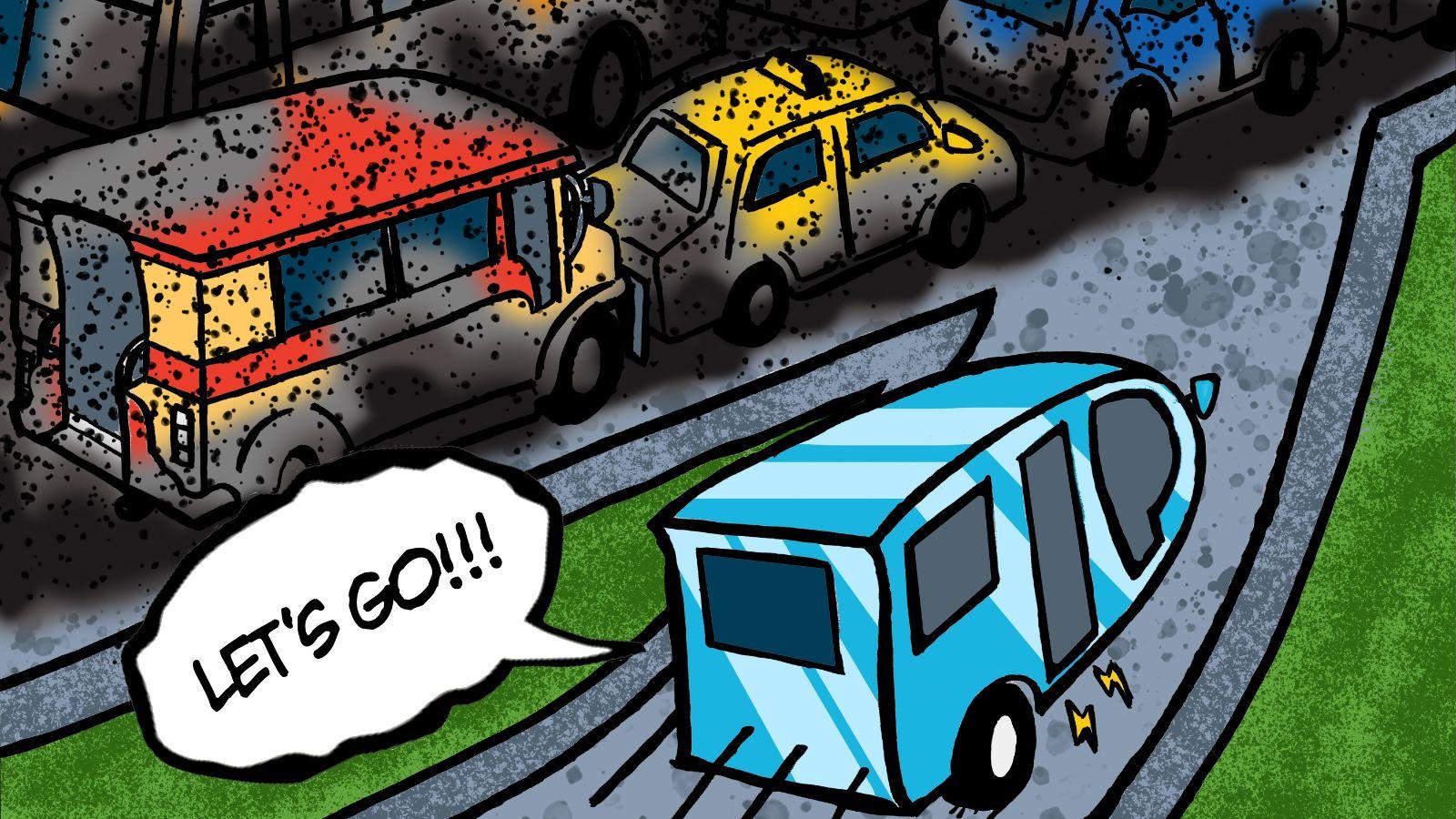
More electric mobility options also address the Philippines’ air pollution woes and their major impact on public health. This because more than half of its outdoor air pollution comes from the transport sector, mainly emissions from vehicles running on gasoline and diesel in traffic-clogged streets.
Transportation is the third largest source of greenhouse gases in the country, as of 2022. Twenty percent of the Philippines’ fuel-combustion GHGs come from the transport sector, mainly from roads, according to the Asian Transport Observatory.
“More e-vehicles on our streets means better conditions for both air and the climate – reduced air pollutants like PM2.5 and nitrous oxides, and less greenhouse gas emissions,” said Vince Pacañot, a climate and energy policy consultant.
ut there is much more to an EV policy that bringing in such vehicles. EV policies need to be woven into the larger picture of the Philippines’ challenging transportation and mobility environment and the need for more liveable communities, as well as issues with fragmented rules, cost and financial support in a country dependent on imported e-vehicles and infrastructure to support the EV ecosystem.
“Electrification is an important step,” Golda Hilario, director for urban development at the Institute for Climate and Sustainable Cities, said in an interview. “But effective governance and a well-coordinated public transport system will ultimately determine the success of transport electrification, whether for two-, three-, or four-wheeled vehicles.”
For instance, she says e-trikes are being promoted in communities “with little regard for product standards and safety by companies.” It is also unclear if the national government sees them as mainly public or private transport, which should shape how they complement, instead of compete, with other modes of mass public transport, she said.
How e-trikes are weaved into the fabric of public transportation systems varies from city to city, which manage these policies. Some 91 cities and local governments have acquired e-trikes as a more sustainable way to improve public transport.
In Pasig, e-trikes used for public transport remain a rarity. This is so although 20 of the 200 lithium-ion-powered e-trikes given by the national government to the city in 2019 went to its tricycle operators, according to the Pasig City Transportation Development and Management Office. It is far more common to see residents driving around in three-wheeled and four-wheeled EVs, and retail businesses using them to transport goods.
In comparison, e-trikes of the same model are a fairly common sight as public utility vehicles in Manila, another component city of the capital region. The Manila city government turned over 50 Japanese-manufactured e-trikes in 2017. Dapitan, a city in southern Mindanao island, rolled out its first six e-trikes to drivers in February 2025.
Earlier initiatives to promote e-trikes as a cleaner and more sustainable mode of transport have had mixed results.
In 2011, the Philippine government embarked on a first step of a project, with the support of the Asian Development Bank, to distribute 20,000 e-trikes nationwide. It expanded this in the following year, through an initiative to roll out 100,000 e-trikes within 5 years to tricycle operators in different cities.
Come 2017, however, the project did not meet its goal due to “significant flaws in the project’s design,” which reportedly included pricing difficulties and inadequate after-sales support. After being scaled down, the project shifted to using a lease-to-own scheme for tricycle drivers. Under this initiative, the popular tourist destination of Boracay in central Philippines adopted e-trikes on a wider scale in 2018.
Cost, maintenance, weather — things to think about
Filipinos have different reasons for embracing – or not embracing – e-bikes and e-trikes. Beyond the price of an EV, the cost of operating it are determining factors, especially for drivers of public-utility tricycles.
Buddy, a long-time tricycle driver in Pasig, says he and his fellow drivers did not warm up to the idea of ‘upgrading’ to e-trikes, which are bigger than the three-wheeled EVs commonly used in the private sector. They worry about the cost of maintaining the e-trikes, though they understand the environmental benefits that EVs bring.
“If the battery breaks down, it would cost 20,000 pesos (340 dollars) to replace it. They’re also more complicated to repair, unlike gas-powered tricycles that you can simply bring to a mechanic to fix,” Buddy pointed out.
The lack of available EV charging stations would also require them to charge the vehicles at home. “You don’t even get to really save on gas in the long run, because electricity is still expensive,” he said. (The Philippines has some of the highest electricity rates in Southeast Asia.)
Rolando recalls spending 7,000 pesos (120 dollars) for a replacement battery. “When I first bought it, I didn’t know how much power it had left or how long I should charge the battery, because it had no battery indicator,” he said. “It ran out of power while I was doing groceries, and so I had to ask a tricycle driver to help me drag it back home. That’s why I replaced the battery and charger.”
“While we do see widespread interest in EVs in the Philippines, the challenge is either on how we could make EVs cheaper, more reliable, and more affordable for the ordinary Pinoy [informal word for ‘Filipino’] to buy one, and if there are reliable charging stations in strategic places for e-trikes to charge their vehicles without buying their own chargers,” said Jonas Dumdum, a sustainability consultant.
Replying to e-mailed questions, a public affairs representative from the Department of Energy identified “insufficient investments in charging systems and services” as one of the struggles of the local EV community. The government will be rolling out EVs outside the capital to improve the charging network and “address EV range anxiety,” the officer said. (The country only had nearly 600 charging stations as of February 2025.)
Then there is the matter of where the electricity in the charging stations comes from – a power grid that is heavily reliant on the burning of fossil fuels.
In the Philippines’ climate action plan, the electrification of transport is among the steps to reduce its greenhouse gas emissions by 75% by 2030. (Unlike most Southeast Asian nations, it does not have a net-zero target.) At the same time, 77.8% of its gross electricity is generated from fossil fuels, consisting of coal (62.5%), oil (1%) and gas (14.2%), according to 2024 statistics from the energy department. Only 22.2% came from power plants using renewable energy, which comprises geothermal, hydro, biomass solar and wind energy sources.
If and when the country shifts to more renewables, this transition would theoretically also make the power used by EVs more climate-friendly as well. In recent years, some solar-powered charging stations have been launched in the Philippines.
For some Filipinos, typhoons and torrential rains are also something to consider when it comes to using EVs. For instance, there are questions – and advice – about how to manage EVs and their lithium batteries during floods at this time of extreme weather events.
Still adjusting to EVs
Policies, rules and systems around EV use have also shifted as the country gets used to having more of them on its streets.
In October 2024, the Land Transportation Office suspended e-bike and e-trike registration in order to update rules around their use, including around registration and safety issues. In April 2024, e-bikes and e-trikes were banned from national roads in an effort to reduce the number of accidents involving them. The lower maximum speed of two- and three-wheeled EVs, at 25 kilometres per hour, is far slower than the 60 kph maximum speed limit for vehicles on national highways.
Overall, “a lack of familiarity with EV technology among both consumers and market players” is currently slowing down the pace of EV adoption in the country, particularly as public transport,” the Department of Energy’s public affairs office said.
Despite the country’s adjustment ‘pains’, some commuters say they welcome the cleaner choices that EVs, including as public transport in the capital’s streets, offer.
“I have tried an e-trike, riding between Mandaluyong City Hall [also in the capital Metro Manila] and my old office [in the same city],” shared Dumdum, describing it as a roomier, quieter and more comfortable alternative to motorized tricycles. “I do wish there would be more.”—Edited by Johanna Son for Reporting ASEAN
Cover photo: Mikael Angelo Francisco


Author: Mikael Angelo Francisco
Bitten by the science writing bug, Mikael has years of writing and editorial experience under his belt. As the editor-in-chief of FlipScience, Mikael has sworn to help make science more fun and interesting for geeky readers and casual audiences alike.