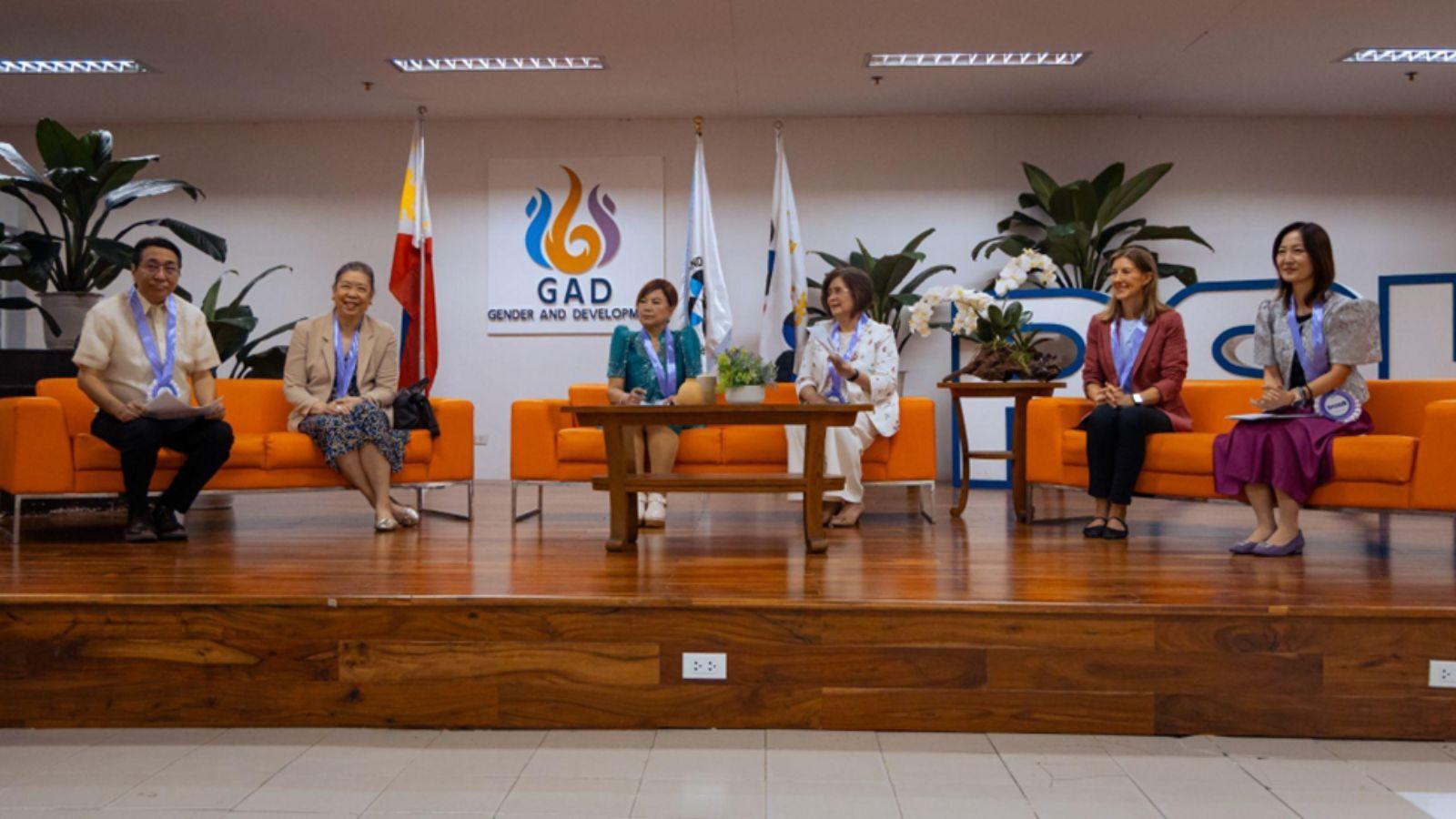
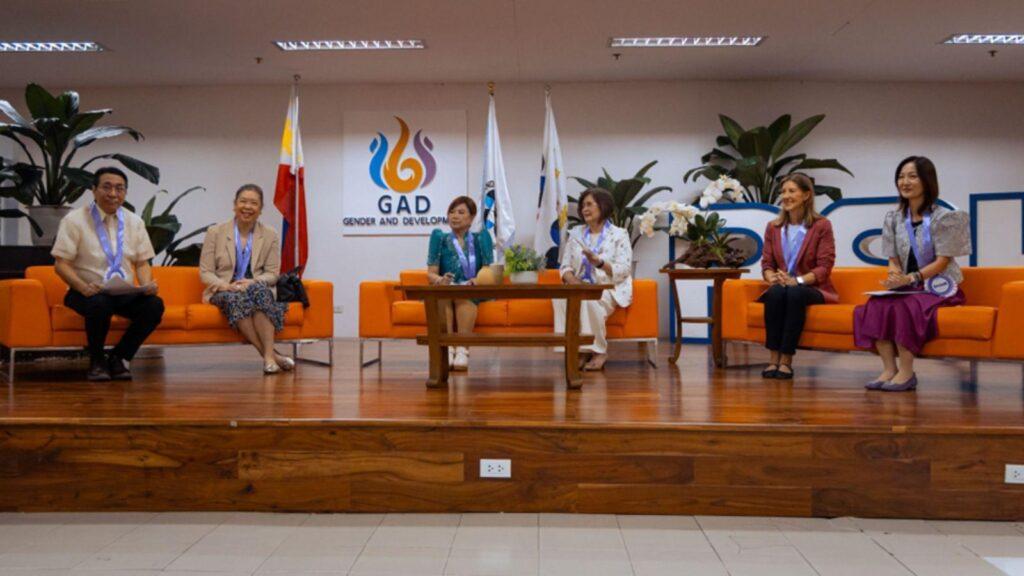
From left: Engr. Albert G. Mariño, Deputy Director of DOST-SEI, Dr. Maria Asuncion A. Silvestre, President of Kalusugan ng Mag-ina, Inc., Ms. Ermelita V. Valdeavilla, Chairperson of the Philippine Commission on Women, DOST Assistant Secretary and DOST GAD Focal Person Diana L. Ignacio, Dr. Catherine Judith Challen, Senior Lecturer from Queensland University of Technology, and Ms. Chieko Yokota, Gender Specialist of the Asian Development Bank, answered questions from invited junior and senior high school students on creating inclusive STEM ecosystems for women and girls. Photo: Patrick James Lee C. Alfonso, DOST-STII
There is a prevailing perception that, from a young age, many girls are told that Science, Technology, Engineering, and Mathematics (STEM)-related courses are not suitable for them. These messages often undermine their confidence and influence their choices and aspirations.
According to the latest report by the United Nations Educational, Scientific and Cultural Organization (UNESCO), only one in three researchers worldwide is a woman, and women account for just 35% of science graduates globally. This reality is also reflected in the Philippines, where male students continue to dominate fields such as engineering, information and communication technologies (ICT), social sciences, and journalism.
“But women should not be discouraged. Through dedication and sustained gender mainstreaming efforts, the Philippines has achieved a notable milestone, with women now comprising 55% of researchers,” shared Department of Science and Technology (DOST) Assistant Secretary for Administrative and Legal Affairs and DOST-wide GAD Focal Person Diana L. Ignacio.
“In DOST, 35% of the Management Committee and 46% of executive officials are women. This proves that women not only excel in STEM fields; they also lead in STEM,” Ignacio emphasized during the special forum held in celebration of the International Day of Women and Girls in Science on February 11, 2026 at the DOST – Philippine Science High School System Main Campus in Quezon City.
She further explained that the contributions of women scientists, engineers, and researchers must be recognized not only every February 11 but every day, through systemic change and targeted interventions.
The gender gap in STEM, she stressed, is not rooted in a lack of ability, but in the persistent barriers women face from early childhood through their professional careers.
Meanwhile, in his message, DOST Secretary Renato U. Solidum Jr. said that closing the gender gap in STEM is not simply a women’s issue, but also a development imperative. Nations that invest in women scientists invest in stronger research, more inclusive technologies, and solutions that respond to real-world needs.
“Vision without action remains an idea — but vision translated into policy, programs, and partnerships creates impact,” he said, adding that when women are present at the table, science becomes more human-centered, more responsive, and more impactful.
Ermelita V. Valdeavilla, Chairperson of the Philippine Commission on Women, encouraged the students to become “women leaders in the field of science and technology.” She spoke about the power of the pre-colonial (predominantly) Filipina spiritual leaders, the babaylan, who served as priestesses, healers, advisers, and conflict mediators. She urged the students to “lead like a babaylan,” emphasizing the ‘power to empower’ rather than power rooted in control or domination.
Bridging the gender gap in STEM participation
Among the invited resource speakers was Chieko Yokota, a Gender Specialist from the Asian Development Bank (ADB), who discussed gender barriers in STEM from a labor force participation perspective. In her presentation, she noted that the Philippines’ female labor force participation rate remains low at about 50%, compared to 72% for men — one of the widest gaps in Asia and the Pacific.
She also highlighted occupational segregation, where women are overrepresented in sectors such as child care, nursing, and teaching, while underrepresented in the STEM fields. Despite near parity in higher education participation in the Philippines, gaps remain in specific STEM sub-sectors, with women still underrepresented in engineering and ICT.
Yokota shared her personal story of being discouraged from pursuing medicine in Japan because she was a girl, emphasizing the importance of self-advocacy, role models, and mentorship.
She explained that ADB integrates gender considerations into all its projects, including financing development initiatives in both the public and private sectors. In STEM, ADB focuses on expanding women’s access to education and technical skills, promoting women’s participation in STEM industries, and advocating for gender-responsive workplace policies.
Dr. Catherine Judith Challen, Senior Lecturer in Mathematics Education at the Queensland University of Technology, emphasized that mathematics serves as the foundation of STEM disciplines and highlighted the critical need for greater diversity in these fields. Drawing from her own career journey — which included a decade in the biotechnology industry before transitioning into education — she illustrated the diverse pathways that can lead to mathematics education and advocacy.
Dr. Challen pointed to a persistent imbalance in representation after high school, particularly in math-intensive fields such as computing and engineering.
“The lower interest among girls in pursuing mathematics-related careers is closely linked to their mathematical identities, as well as the influence of gender stereotypes and the prevalence of ‘math anxiety’ among female students,” Dr. Challen shared.
To address these challenges, her research promotes “ambitious teaching,” a discussion-based approach that prioritizes deep conceptual understanding. This strategy aims to foster confidence and engagement in mathematics, especially among girls.—Allan Mauro V. Marfal (Press release from DOST-STII)/MF
The 2026 International Day of Women and Girls in Science special forum was spearheaded by the DOST Gender and Development (GAD) Unit, is one of the initiatives of the Department of Science and Technology (DOST) aimed at providing science-based interventions through innovative, and inclusive solutions across four strategic pillars: human well-being, wealth creation, wealth protection, and sustainability. These pillars embody the mantra OneDOST4U: Solutions and Opportunities for All. For more information, visit www.dost.gov.ph.