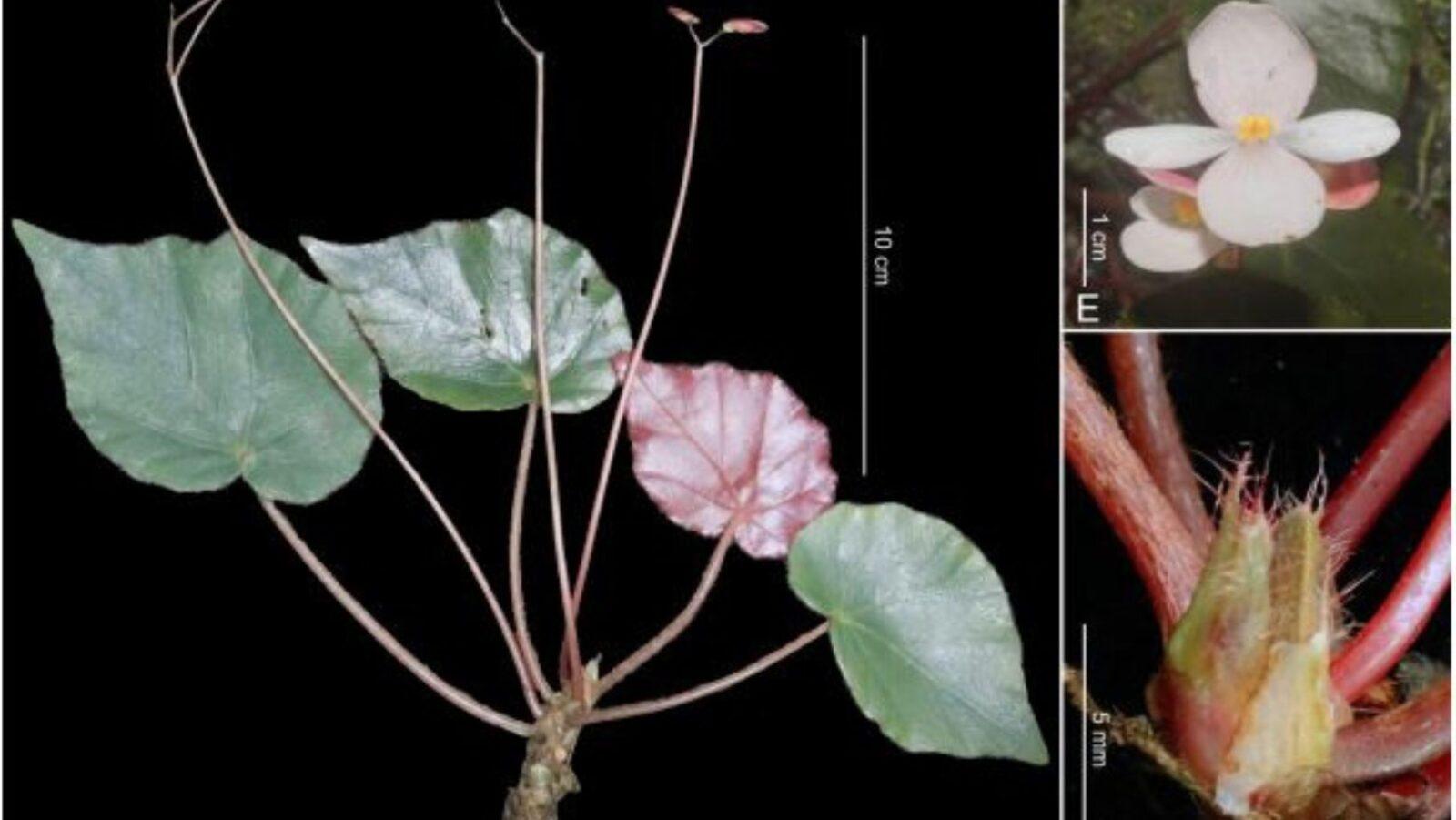
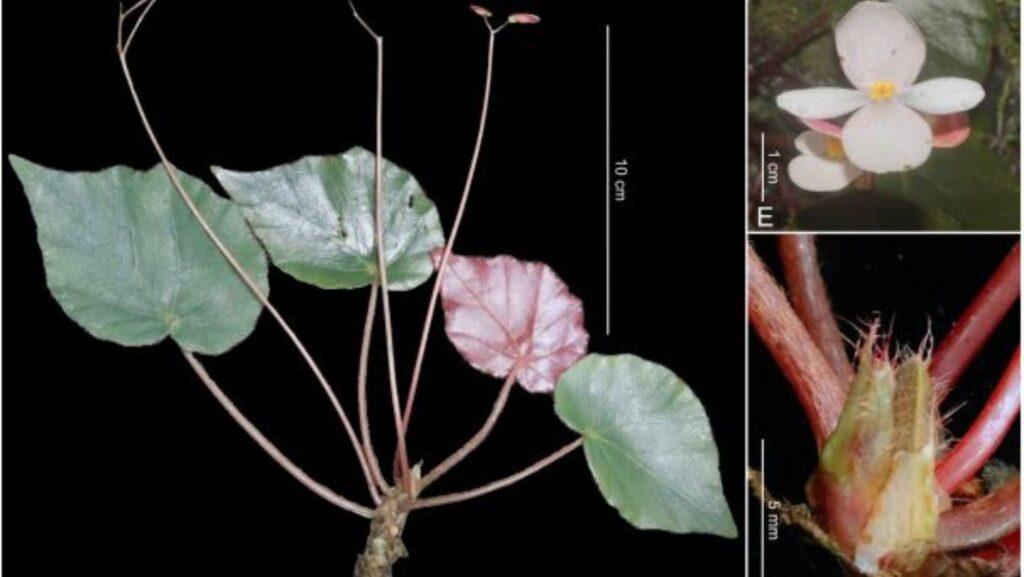
In March 2026, the description of Begonia occidentalis, a new species of flowering plant from the Philippines, was published by Mark Arcebal K. Naive, Bobby B. Alaman, Grace V. Villanueva, Melbert James G. Baul, and Donnafe J. Ancheta in the journal Phytotaxa.
𝘽𝙚𝙜𝙤𝙣𝙞𝙖 𝙤𝙘𝙘𝙞𝙙𝙚𝙣𝙩𝙖𝙡𝙞𝙨
Distribution/habitat: Misamis Occidental & Zamboanga Peninsula, Western Mindanao
Endemic: Yes
Distinctive traits: Known only from one locality and with fewer than 50 mature individuals observed, Begonia occidentalis bears certain physical similarities to both B. copelandii from Southern Mindanao and B. rubrifolia from Panay Island. However, B. occidentalis has arachnoid petioles (hairy leaf stalks) and a larger capsule (dry fruit that contains seeds) than B. copelandii, smaller inflorescence (flowers or flower clusters) and weakly branching rachis (the stem to which flower stalks are attached) compared to B. rubrifolia, and other traits that merit its classification as a unique species. B. occidentalis also has noticeable physical differences — like its smaller size and irregularly trapezoid capsule with strongly unequal wings — from other known Begonia species within the Zamboanga Peninsula (B. anisoptera and B. sebodensis), making it relatively easier to distinguish from them.
Conservation status: Critically Endangered (provisional, based on IUCN Red List standards)
Etymology: Begonia occidentalis takes its name from the Latin word for “west”/”western,” as it was discovered in the Western Mindanao region.
Significance
According to the researchers, within the last few decades, there have been no new plant species descriptions from the Mount Malindang Range Natural Park (MMRNP), an “ecologically significant” protected area spanning Misamis Occidental and parts of Zamboanga del Norte and Zamboanga del Sur. MMRNP is the only remaining representative natural forest within the Zamboanga Peninsula. Thus, the description of B. occidentalis — the first record of a Begonia species under the section Baryandra in MMRNP, third for the Zamboanga Peninsula — is both a testament to the region’s rich biodiversity and the need for further conservation-centric exploration and protection initiatives (e.g., regulating tourism activities, which are manmade disturbances with the potential to negatively affect the species in the area if uncontrolled).—MF
Reference: Naive, M.A.K., Alaman, B.B., Villanueva, G.V., Baul, M.J.G. & Ancheta, D.J. (2026) Begonia occidentalis (Begoniaceae, section Baryandra), a new species from Mindanao Island, southern Philippines with notes on B. copelandii. Phytotaxa 749 (1): 95–102. https://doi.org/10.11646/phytotaxa.749.1.7


Author: Mikael Angelo Francisco
Bitten by the science writing bug, Mikael has years of writing and editorial experience under his belt. As the editor-in-chief of FlipScience, Mikael has sworn to help make science more fun and interesting for geeky readers and casual audiences alike.