
Nutrition gaps that weaken immunity, threaten eyesight, and affect brain development remain a concern among Filipinos, particularly young children and pregnant women, according to the latest findings of the 2023 National Nutrition Survey (NNS) conducted by the Department of Science and Technology – Food and Nutrition Research Institute (DOST-FNRI). Often referred to as “hidden hunger,” these gaps occur when people consume diets that lack essential vitamins and minerals such as vitamin A and iodine.
The survey revealed that approximately 3 in every 100 Filipinos (2.8%) have vitamin A deficiency (VAD), with the highest prevalence among preschool children aged 6 months to 5 years (13.9%), reflecting a ‘moderate level’ of public health significance. School-age children (7.0%) and pregnant women (4.1%) showed notable levels considered of ‘mild’ public health significance. On the other hand, lower rates were observed among adolescents (2.0%), lactating mothers (1.7%), non-pregnant/non-lactating women (1.5%), adults (0.9%), and older persons (0.9%).
Vitamin A helps protect eyesight and supports the immune system. When intake is too low, children become more vulnerable to infections and, in severe cases, may suffer from visual problems. Among pregnant women, adequate vitamin A is important for maternal and child health.
The 2023 NNS also assessed iodine nutrition, which is essential, especially during pregnancy, for fetal brain development. Most population groups showed adequate iodine levels, reflecting adequate iodine nutrition. However, pregnant women recorded levels below the recommended range of 150-249 μg/L, indicating insufficient iodine intake and iodine deficiency. In addition, 1 in 5 older persons and lactating mothers were found to have very low iodine levels (<50 μg/L), suggesting that gaps remain in certain sectors.
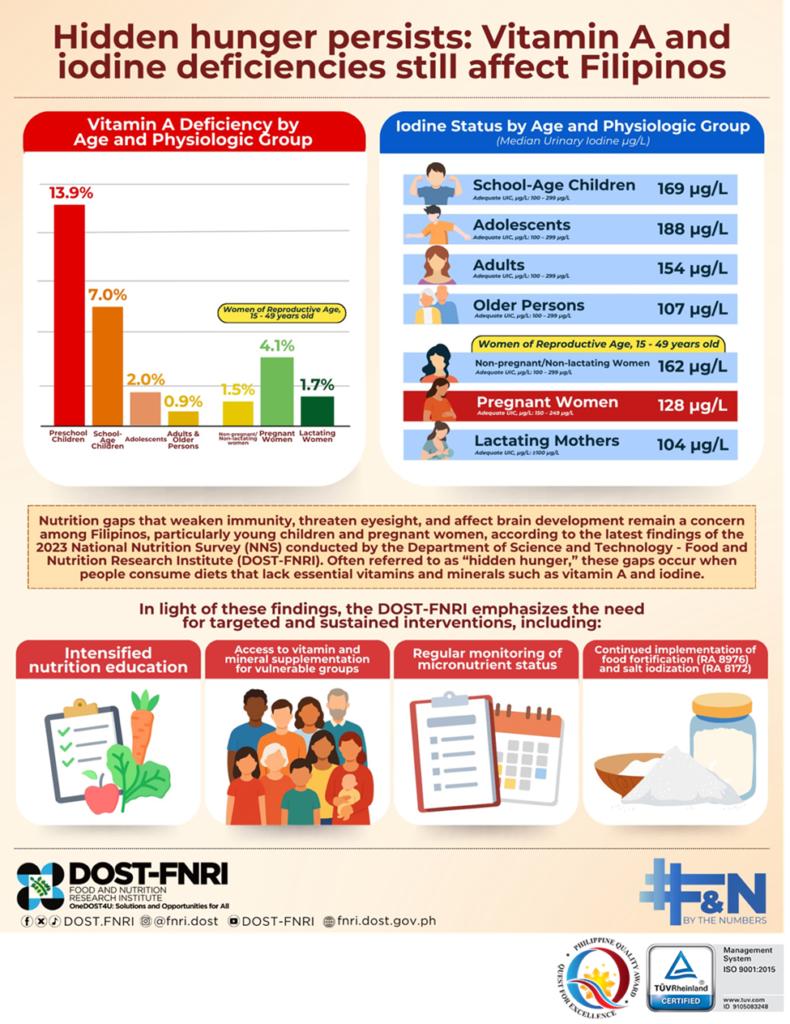
In light of these findings, the DOST-FNRI emphasizes the need for targeted and sustained nutrition programs for high-risk groups, particularly preschool children, pregnant women, lactating mothers, and older persons. Recommended interventions include intensifying nutrition education for families and communities, improving access to vitamin and mineral supplementation for vulnerable groups, and continuing regular monitoring of micronutrient status to support effective and evidence-based nutrition policies.
The Institute also underscores the importance of the continued implementation of food fortification and salt iodization, as mandated by Republic Act No. 8976 and Republic Act No. 8172, respectively. Proper coordination among national agencies, local government units, and food manufacturers is crucial to ensure that fortified foods and iodized salt reach Filipino households. To further promote and encourage compliance in salt iodization, incentives such as tax deductions are recommended for manufacturers that meet iodization standards.
As the Institute prepares for the release of the 2025 Updating of the Nutritional Status of Filipino Children and Other Population Groups, also known as the 2025 Updating Survey, DOST-FNRI continues to unpack key findings from the 2023 survey to provide deeper context and actionable insights. These releases serve as an important baseline for understanding nutrition trends and informing evidence-based decisions ahead of the upcoming survey results.
The DOST-FNRI encourages policymakers, local governments, researchers, and the public to access official nutrition statistics through eNutrition, the Institute’s online data portal. The platform provides reliable, up-to-date findings from the National Nutrition Survey to support informed decisions and stronger community action.—Press release from DOST-FNRI/MF
The Food and Nutrition Research Institute is one of the attached agencies of the Department of Science and Technology (DOST) aimed at providing science-based, innovative, and inclusive solutions across four strategic pillars: human well-being, wealth creation, wealth protection, and sustainability. These pillars embody the mantra OneDOST4U: Solutions and Opportunities for All. For more information, visit www.fnri.dost.gov.ph