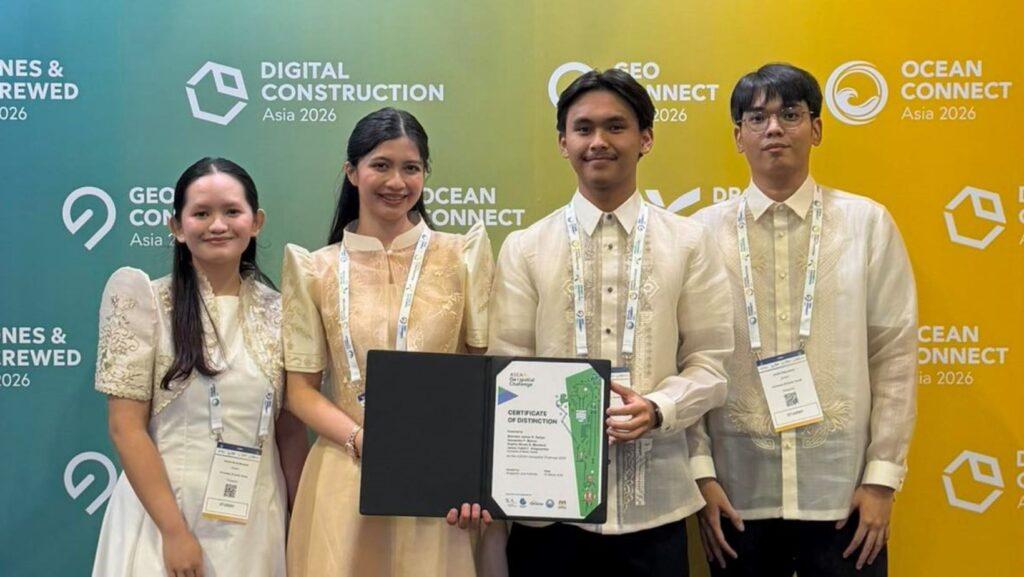
Team EMPATH (L-R): Sophia Nicole Mendoza, Samantha Muñoz, Brendan James Saripe and James Kaleb Graycochea. (Photo: Shie Muñoz)
A team of undergraduate biology students from the University of Sto. Tomas (UST) received the Distinction Award at the 2026 ASEAN Geospatial Challenge for their proactive decision support system for managing plastic pollution in a crucial Metro Manila river system.
Created by Team EMPATH — team leader Brendan James Saripe (3rd year BS Medical Biology) and team members James Kaleb Graycochea (2nd year BS Environmental Biology), Sophia Nicole Mendoza (3rd year BS Medical Biology), and Samantha Muñoz (3rd year BS Medical Biology), coached by Dr. Nikki Heherson Dagamac and Almyt Poblete — the web-based tool, called PATH (Plastic Assessment, Tracking, and Hotspots), forecasts high-risk areas for plastic pollution along the MANATUTI (Malabon-Navotas-Tullahan-Tinajeros) river system, providing data-based insights for efficient waste and waterway management.
Team EMPATH presented their project at Geo Connect Asia 2026, held in the Sand Expo and Exhibition Hall in Singapore on March 31.
PATH: A proactive approach to plastic waste management
“The MANATUTI river system flows from Caloocan, Malabon, Navotas, Quezon City, and Valenzuela City in the Philippines,” the students explained in their video pitch for the competition, which was organized by the Singapore Land Authority. “Over the years, it became a major pathway for macro and mesoplastic waste due to high-density urban poverty, plastic use, and overwhelmed waste systems, causing multisectoral damage and losses.”
PATH combines three tools to provide “location-based index scores” of places that can become plastic pollution threats: A gap map of MRFs (materials recovery facilities) that helps identify which communities have limited waste recovery services and a high risk of plastic leakage, a flush-event dashboard that shows likely pathways of plastic waste during rainfall (helpful for targeted prevention, interception, and cleanup operations), and a map of typical plastic waste accumulation spots. According to the team, this can enable families to prepare adequately for floods, fisherfolk to ensure the quality of their catches, and city planners to identify urgent areas for waste facility construction.
For the project, the students took inspiration from the 2019 ASEAN Framework of Action on Marine Debris, aligning PATH with the United Nations’ Sustainable Development Goals 11 (Sustainable Cities and Communities), 12 (Responsible Consumption and Production), and 14 (Life Below Water).—MF

Author: Mikael Angelo Francisco
Bitten by the science writing bug, Mikael has years of writing and editorial experience under his belt. As the editor-in-chief of FlipScience, Mikael has sworn to help make science more fun and interesting for geeky readers and casual audiences alike.