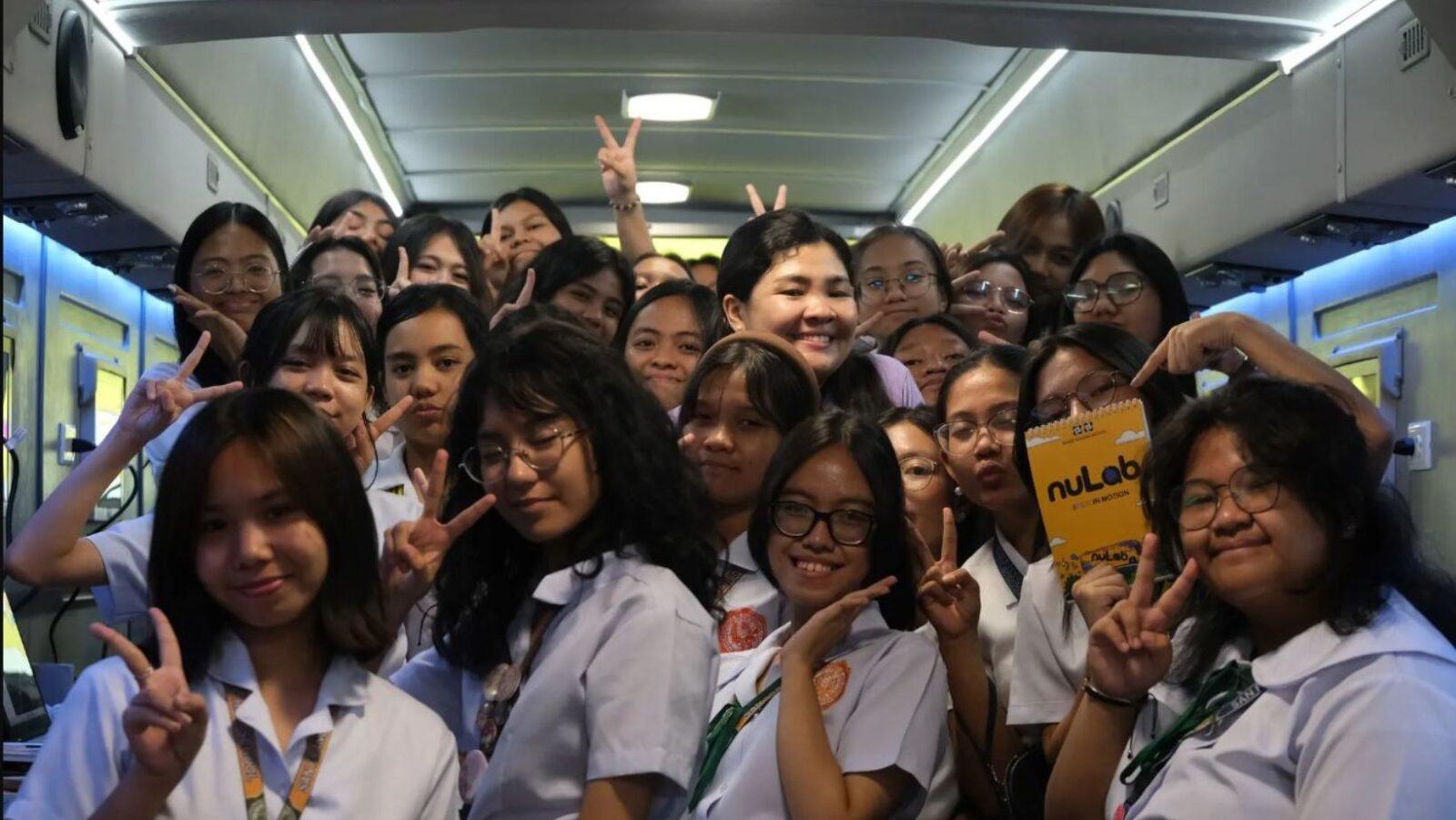
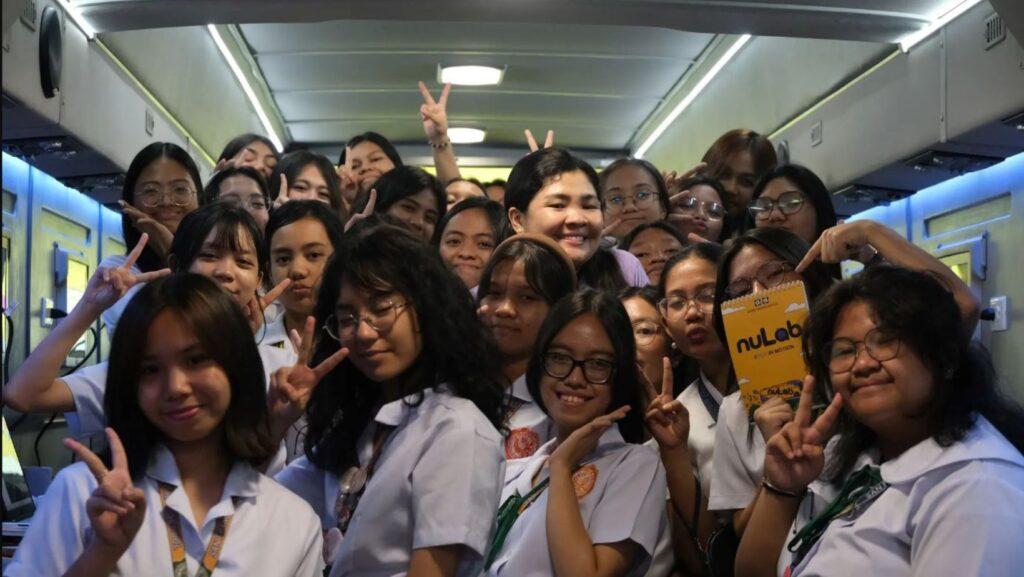
Dr. Pamela Louise Tolentino poses with the student attendees of her nuLab Environmental Science session. (Photo: DOST-SEI)
Bringing science closer to communities, DOST-SEI’s nuLab began its 2026 trips with women scientists and an all-girl mobile classroom at the Philippine Science High School – Main Campus in Diliman, Quezon City, on February 11, 2026.
A mobile laboratory that transforms learning into an immersive experience, nuLab enables students to engage with science through hands-on activities, real-world applications, and direct conversations with experts in the field.
In celebration of the International Day of Women and Girls in Science, nuLab welcomed students from San Francisco High School and Quezon City Science High School for three specialized sessions by Filipina scientists.
Dr. Vallerie Ann Samson, Deputy Director and Chairperson of the Gender and Development Focal Point System of the DOST Philippine Nuclear Research Institute (DOST-PNRI), facilitated a session on Nuclear Science. She introduced students to the fundamentals of nuclear science and its many applications in medicine, agriculture, energy, and industry, demonstrating how nuclear technologies quietly but profoundly contribute to addressing real-world challenges.
Sharing her extensive knowledge of river systems, Dr. Pamela Louise Tolentino led a session on Environmental Science. A Filipina scientist from the University of Glasgow in the United Kingdom, she discussed how rivers are living, dynamic systems that shape ecosystems, sustain communities, and influence the landscapes through which they flow.
Finally, Dr. Sheryl Lyn Monterola, Director of the University of the Philippines National Institute for Science and Mathematics Education Development (UP NISMED), guided students in navigating their paths in the sciences during the Nurturing STEM Identity session. She encouraged students to reflect on their evolving relationship with science, emphasizing the importance of confidence, mentorship, and representation in shaping a young person’s journey into STEM.
Encouraging the next generation
Beyond scientific concepts and hands-on experimentation, all three sessions highlighted personal reflections from the Filipina scientists about their professional journeys.
“In many conferences I’ve attended, I often felt the need to be the first woman to raise a question,” Dr. Samson shared. “Once one woman speaks up, others tend to follow. Sometimes, all it takes is seeing someone like you [to] take that first step.”
This reflection is like Dr. Tolentino’s, but for her, taking space as a woman is paving the way for young women as well. “When young women see someone like them in science, it becomes easier to believe that they belong in that space too,” she explained. Being a role model for fellow Filipinas builds a “sense of connection” that boosts their confidence in STEM and encourages them to keep going.
Highlighting the value of perseverance, Dr. Monterola reminded her class, “For women, it’s important to embrace a growth mindset and [to] keep going despite challenges.” For her, building a career in STEM is an everyday choice. “It’s not just about being brilliant for a moment, but about sustaining that brilliance. Being consistent, pushing through setbacks, and believing that you can succeed no matter how difficult the path may be,” she expressed.
Receptive to these insights, many participants felt inspired to pursue STEM moving forward. It also made the seemingly distant and abstract field of STEM more human to them. Above all, the students expressed that this experience was a meaningful moment of reflection that helped bridge aspirations and possibilities.
Why exposure matters
These interactions between scientists and students are at the heart of nuLab’s mission. While many young Filipinos are eager to explore science, access to meaningful opportunities can still be limited by resources and infrastructure. For young Filipinas in particular, STEM can feel out of reach in spaces where they remain underrepresented.
Held alongside the International Day of Women and Girls in Science, nuLab’s first trip of 2026 highlights the importance of visibility and connection. By bringing women scientists directly into learning spaces, the program shows students what is possible and who they can become.
More than a mobile laboratory, nuLab is a bridge that links curiosity with opportunity, and classrooms with real-world science.
As it travels across the country this year, nuLab carries a simple but powerful message that science is not confined to laboratories or textbooks. It is not distant. It lives in questions, in communities, and in every young mind willing to explore and imagine something more. It is a young learner’s opportunity to see, experience, and ultimately become part of it.—Press release via DOST-SEI/MF