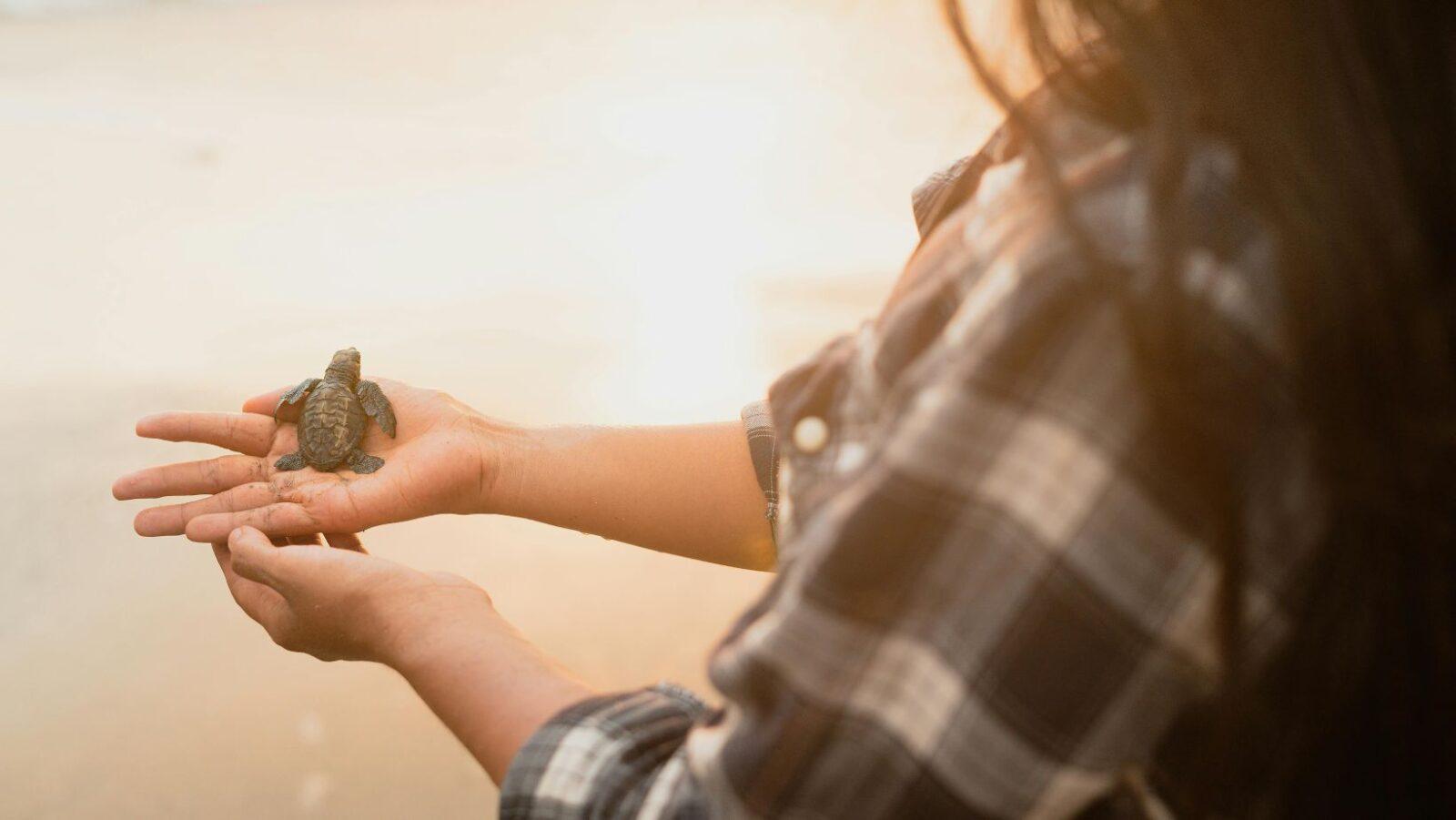
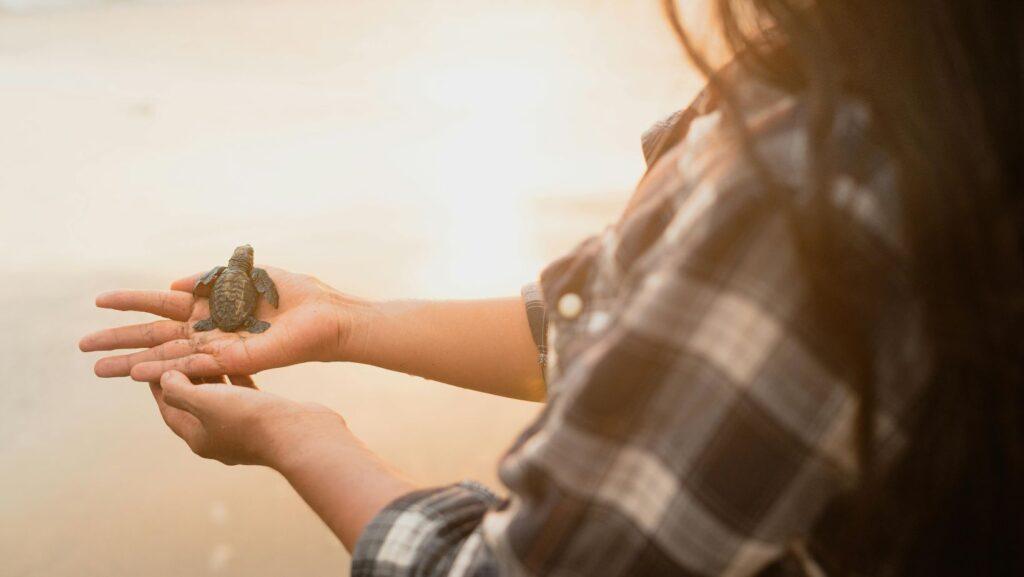
A girl holds a baby sea turtle in her palm. (Photo: Los Muertos Crew/Pexels)
The year 2019 saw the emergence of the Internet phenomenon known as VSCO girls (or VSCO kids). Named after VSCO — a photo-editing app that the Guardian described as “a kind of Instagram 2.0” — these Gen Z teenagers sported brightly colored oversized t-shirts worn over athletic shorts, with Crocs or Birkenstocks to match. Described to be practically indistinguishable from one another, scrunchies held up their very high ponytails, shell necklaces adorned their necks, and friendship bracelets took up all available real estate on their forearms.
Beyond style and aesthetic, one theme united all VSCO girls: environmentalism. With a battle cry of “save the turtles,” they promoted plastic-free lifestyles among their Gen Z peers. In response to viral videos where sea turtles had ingested plastic straws pulled out of their noses, metal straws became the popular alternative. To reduce single-use plastics, they are credited for the insulated metal water bottle craze that began with the Hydro Flask, the effect of which we still see today with Stanleys, Owalas, and AquaFlasks.
In 2025, the conservation status of the green sea turtle (Chelonia mydas) changed from Endangered to Least Concern. Classified by the International Union for Conservation of Nature (IUCN), the green sea turtle had been holding its endangered status since 1982.
With the landmark reclassification coming only six years after the VSCO girls made waves all around the Internet, many online users have pondered if these teenagers had anything to do with it, with a national lifestyle publication even claiming so outright.
A history of sea turtle conservation
The green sea turtle is only one of seven sea turtle species and, following its recent reclassification, is the only species not considered to be Vulnerable or Critically Endangered. Making a remarkable case for the success of conservation efforts worldwide, it’s no wonder that many are eager to know what worked and why — hence the fascination with whether a viral cultural phenomenon online played any role.
A notable trait of sea turtles is their ability to be found almost anywhere on the planet. They can be found in six of the seven continents and in nearly all types of marine ecosystems (except polar regions), including the open sea, reefs, coastal waters, and even estuaries, which are aquatic ecosystems where freshwater rivers meet seawater at the coast. Because of their widespread reach, humans have been benefiting from sea turtles for thousands of years for their skin and shells for clothes and accessories, as well as their meat and eggs as food.
In the late 1800s, sea turtles began to be overexploited and over-hunted. These living fossils — the earliest sea turtle was found to live 120 million years ago! — soon found themselves the victims of poaching and of bycatch as a product of commercial fishing, where they are accidentally captured and harmed by fishing gear. As a result of mass industrialization, their habitats quickly began to degrade.
By the 1950s, sea turtle populations across the seven known species had dwindled enough to be a concern, prompting scientists and conservationists to direct their attention towards saving them. Having the most number of nesting sites around the world and being the most geographically widespread species, the green sea turtle found itself garnering the most attention in research and conservation among the seven sea turtle species.
The verdict: VSCO girls did not “save” the sea turtle
A review published in 2025 found that while there has been a steady rise globally in published scientific papers on sea turtles since 1956, there was an exponential increase from 2016 to 2023. Another study that assessed sea turtle research done in the Mediterranean Sea marked an exponential increase to begin in 2010, six years earlier than in the global analysis. These measured increases in the number of scientific papers published also indicate an increase in funding, which is a direct and measurable input from government agencies, corporations, and private donors.
Moreover, 2010 was the year that an international group of 35 sea turtle researchers, the Marine Turtle Specialist Group under the IUCN (the same institution that classifies threatened, vulnerable, and endangered species), refined research priorities down to 20 questions. This way, scientists all over the world were given guidance and direction as to what aspects of sea turtle research were to be prioritized in the effort of conserving them, possibly explaining the increased volume of sea turtle research thereafter.
These steep trends were observed to have started years before VSCO girls came onto the scene, showing that the marked increase in research and conservation efforts were already in full swing long before these girls took hold of the Internet. In the aforementioned 2025 global review, the authors credited the increase to the development of more integrated approaches to conservation. These approaches extended past the reaches of just science, where strategies involved nonprofit organizations in monitoring, management, and mobilization, and the government in enforcement and protection.
While the common claim is that the boosted popularity of environmentalism aided conservation efforts, evidence shows that it is actually the other way around. Following decades of conservation efforts that evolved to be more inclusive and more integrative than their predecessors, the VSCO girl trend in 2019 showed us how conservation finally broke into the mainstream. It cannot be denied that the trend has likely raised awareness in the practice of eco-conscious habits, especially among Gen Z teens, but as far as the data goes, this places the win solidly on the scientists and conservation professionals that spent decades and dedicated their careers to the research and application of this research for the benefit of the species.
In defense of the teenage girl
The VSCO girl trend was very much rooted in the well-intentioned spirit of environmentalism. Daniel Benkendorf, a psychology professor with the Fashion Institute of Technology, says in an interview with the Guardian that young women especially are the target demographic of brands that advertise themselves as sustainable, as it has been found that these young women are most likely to take a brand’s ethics into consideration when buying products.
Environmentalists have pointed out as early as its peak in 2019 that a downside to this aesthetic trend is that these same teenage girls feel pressured to buy multiples of the same popular brands of clothing, footwear, accessories, and, yes, water bottles in order to keep up appearances and perceived social status. Despite touting sustainability, the products ended up being marketed online by companies to actually encourage overconsumption, which counters environmentalism. What could have been an opportunity for long-lasting environmental impact became a passing fad that, in the big picture, really only benefited corporate profit margins.
This may be an opportunity to take stock of how we navigate the relationship between society and the environment. Are these same corporations advertising sustainability doing enough, especially since they are the primary drivers of waste production and habitat loss that cause biodiversity decline in the first place? Are governments establishing the appropriate policies that aid conservation and keep these corporations in check? Are the youth being properly educated on what they consume and how it affects the ecosystems they live in?
Lest we forget — it was never on the VSCO girl to save the planet in the first place.—MF
References:
- https://www.worldwildlife.org/species/sea-turtle/
- https://earthsky.org/earth/sea-turtles-lifeform-of-the-week/
- https://lifestyle.inquirer.net/553811/how-conservation-and-vsco-girls-saved-green-sea-turtles/
- https://www.seaturtlestatus.org/green-turtle#:~:text=Green%20Sea%20Turtle,eggs%20continue%20to%20be%20consumed
- https://www.sciencedirect.com/science/article/abs/pii/S0964569125003254?fr=RR-2&ref=pdf_download&rr=9e548cfa7e5d0721
- https://www.int-res.com/journals/esr/articles/esr00801
- https://www.int-res.com/journals/esr/articles/esr00901
- https://www.iucn-mtsg.org/about
- https://www.iucn-mtsg.org/burning-issues
- https://www.iucn-mtsg.org/global-conservation-priorities
- https://www.sustainablemillennial.com/home/2019/10/17/vsco-girls-the-good-the-bad-and-the-green
- https://www.sciencedirect.com/science/article/abs/pii/S0964569125003254?fr=RR-2&ref=pdf_download&rr=9e548cfa7e5d0721
- https://harnessmagazine.com/how-vsco-girls-are-not-saving-the-turtles/